
This study examined the determination of BOD in landfill leachates by dilution (D-method) and manometric methods (M-method). The differences in results were discussed based on statistical tests.
Serial Vs Parallel Dilution Method. L of dilution liquid in the tube 1: 1. Thoroughly mix tube 1: 1. Again, mix the tube 1: 1. The solution from test tube 1: 1. Extend this procedure to perform longer serial dilutions. This process may be repeated as many times as necessary to achieve the desired solution.
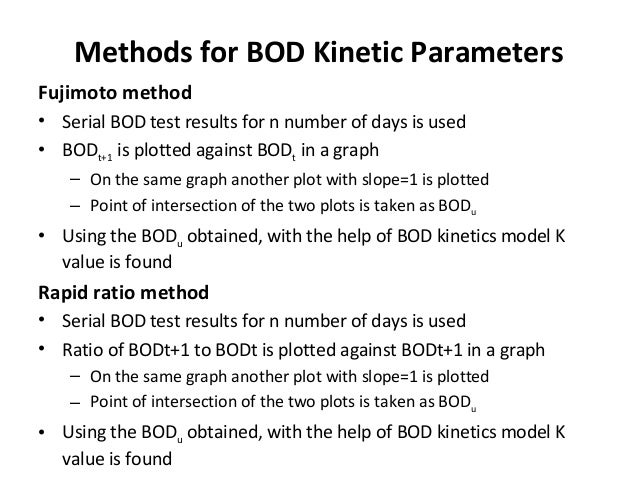
The effects of sample dilution, seeding, chloride and total Kjeldahl nitrogen (TKN) level were examined. The M-method was found to be more sensitive to increases in chloride and TKN concentrations. However, in the M-method the positive interference of nitrogenous BOD (NBOD) to carbonaceous BOD (CBOD) was more successfully prevented. The BOD rate constant k and the ultimate BOD (BOD u) were estimated by non-linear regression.
With the M-method these parameters could be more reliably estimated than the D-method. Suggestions were made for BOD analyses in landfill leachates in future studies. • For reproduction of material from NJC: Reproduced from Ref. XX with permission from the Centre National de la Recherche Scientifique (CNRS) and The Royal Society of Chemistry.
• For reproduction of material from PCCP: Reproduced from Ref. XX with permission from the PCCP Owner Societies. Chit kodi dlya igri aleksandr makedonskij. • For reproduction of material from PPS: Reproduced from Ref.
XX with permission from the European Society for Photobiology, the European Photochemistry Association, and The Royal Society of Chemistry. • For reproduction of material from all other RSC journals and books: Reproduced from Ref. XX with permission from The Royal Society of Chemistry. If the material has been adapted instead of reproduced from the original RSC publication 'Reproduced from' can be substituted with 'Adapted from'.
In all cases the Ref. XX is the XXth reference in the list of references. If you are the author of this article you do not need to formally request permission to reproduce figures, diagrams etc. Contained in this article in third party publications or in a thesis or dissertation provided that the correct acknowledgement is given with the reproduced material.
Reproduced material should be attributed as follows.
HIAC just got easier! Built on the foundation of the world’s best selling liquid particle counter, the new HIAC 9703+ provides user-friendly features that save valuable operator time. Key Features: • Use less sample – industry’s smallest tare volume • Enjoy more walk away time – automated cleaning routines • Preconfigured compendial test recipes for injectable drugs, ophthalmic solutions and inhalants • Bubble and sensor contamination alarms eliminate uncertainty from data anomalies Preconfigured Compendial Test Recipes: • USP • USP • KP • EP • JP • Inhalents With comprehensive local and on-site programs providing turn-key SOP and IQ/OQ validation services, customers can be assured that the HIAC instrument is ready-to-use straight out-of-the-box. The instrument diagnostics will even notify the customer when new regulatory updates become available or the instrument is due for calibration or routine service. Sample Flow Rate 10 to 100 ml/min; Actual flow rate for the system is determined by the sensor’s flow rate with step-by-step instructions and Pass/Fail results.
Tare Volumes for Probes 0.091 ml for 81 L X 1.2 ID mm (3.2 X 0.047 inches) 0.172 ml for 154 L X 1.2 ID mm (6.1 X 0.047 inches) 1.57 ml for 140 L X 6.35 ID mm (5.5 X 0.25 inches) - large bore Standard Sensors Range HRLD-150 1.3 µm to 150 µm HRLD-150JA 1.3 µm to 150 µm (chemical compatibility) HRLD-400 2 µm to 400 µm HRLD-600JS 2 µm to 600 µm (chemical compatibility).
- Author: admin
- Category: Category
This study examined the determination of BOD in landfill leachates by dilution (D-method) and manometric methods (M-method). The differences in results were discussed based on statistical tests.
Serial Vs Parallel Dilution Method. L of dilution liquid in the tube 1: 1. Thoroughly mix tube 1: 1. Again, mix the tube 1: 1. The solution from test tube 1: 1. Extend this procedure to perform longer serial dilutions. This process may be repeated as many times as necessary to achieve the desired solution.
The effects of sample dilution, seeding, chloride and total Kjeldahl nitrogen (TKN) level were examined. The M-method was found to be more sensitive to increases in chloride and TKN concentrations. However, in the M-method the positive interference of nitrogenous BOD (NBOD) to carbonaceous BOD (CBOD) was more successfully prevented. The BOD rate constant k and the ultimate BOD (BOD u) were estimated by non-linear regression.
With the M-method these parameters could be more reliably estimated than the D-method. Suggestions were made for BOD analyses in landfill leachates in future studies. • For reproduction of material from NJC: Reproduced from Ref. XX with permission from the Centre National de la Recherche Scientifique (CNRS) and The Royal Society of Chemistry.
• For reproduction of material from PCCP: Reproduced from Ref. XX with permission from the PCCP Owner Societies. Chit kodi dlya igri aleksandr makedonskij. • For reproduction of material from PPS: Reproduced from Ref.
XX with permission from the European Society for Photobiology, the European Photochemistry Association, and The Royal Society of Chemistry. • For reproduction of material from all other RSC journals and books: Reproduced from Ref. XX with permission from The Royal Society of Chemistry. If the material has been adapted instead of reproduced from the original RSC publication 'Reproduced from' can be substituted with 'Adapted from'.
In all cases the Ref. XX is the XXth reference in the list of references. If you are the author of this article you do not need to formally request permission to reproduce figures, diagrams etc. Contained in this article in third party publications or in a thesis or dissertation provided that the correct acknowledgement is given with the reproduced material.
Reproduced material should be attributed as follows.
HIAC just got easier! Built on the foundation of the world’s best selling liquid particle counter, the new HIAC 9703+ provides user-friendly features that save valuable operator time. Key Features: • Use less sample – industry’s smallest tare volume • Enjoy more walk away time – automated cleaning routines • Preconfigured compendial test recipes for injectable drugs, ophthalmic solutions and inhalants • Bubble and sensor contamination alarms eliminate uncertainty from data anomalies Preconfigured Compendial Test Recipes: • USP • USP • KP • EP • JP • Inhalents With comprehensive local and on-site programs providing turn-key SOP and IQ/OQ validation services, customers can be assured that the HIAC instrument is ready-to-use straight out-of-the-box. The instrument diagnostics will even notify the customer when new regulatory updates become available or the instrument is due for calibration or routine service. Sample Flow Rate 10 to 100 ml/min; Actual flow rate for the system is determined by the sensor’s flow rate with step-by-step instructions and Pass/Fail results.
Tare Volumes for Probes 0.091 ml for 81 L X 1.2 ID mm (3.2 X 0.047 inches) 0.172 ml for 154 L X 1.2 ID mm (6.1 X 0.047 inches) 1.57 ml for 140 L X 6.35 ID mm (5.5 X 0.25 inches) - large bore Standard Sensors Range HRLD-150 1.3 µm to 150 µm HRLD-150JA 1.3 µm to 150 µm (chemical compatibility) HRLD-400 2 µm to 400 µm HRLD-600JS 2 µm to 600 µm (chemical compatibility).