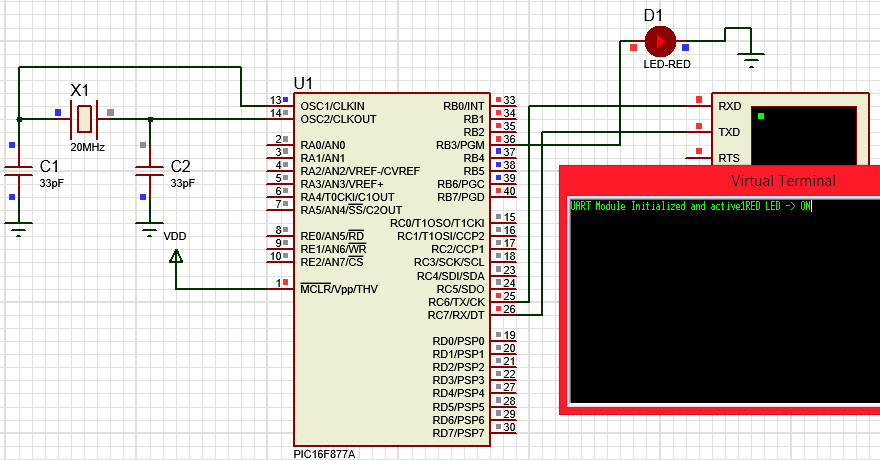

PIC 16F877 series normally has five input/output ports. They are used for the input/output interfacing with other devices/circuits. Most of these port pins are multiplexed for handling alternate function for peripheral features on the devices.
All ports in a PIC chip are bi-directional. Mapfactor navigator 12 keygen generator software. When the peripheral action is enabled in a pin, it may not be used as its general input/output functions. The PIC 16F877 chip basically has 5 input/output ports.
The five input/output ports and its functions are given below. When enabling peripheral functions, more care should be taken in defining TRIS bits for each PORT C pin as compared to other. Some peripherals override the TRIS bit to make a pin an output, while other peripherals override the TRIS bit to make a pin an input.
Pic16f690 Serial Communication C Code Syntax. Serial Port and RS- 2. In this tutorial we are going to learn how use TX & RX pins for serial communication to your PC.
Since the TRIS bit override is in effect while the peripheral is enabled, read-modify write instructions (BSF, BCF, and XORWF) with TRISC as the destination, should be avoided. The user should refer to the corresponding peripheral section for the correct TRIS bit settings. PORT E has only three pins (RE0/RD/AN5, RE1/WR/AN6 and RE2/CS/AN7) which are individually configurable as inputs or outputs. These pins controllable by using its corresponding data direction register “TRIS E”. These pins also have Schmitt Trigger input buffers. The PORT E pins become the I/O control inputs for the microprocessor PORT when bit PSPMODE is set.
In this mode, the user must make certain that the TRIS E bits are set and that the pins are configured as digital inputs. Also, ensure that ADCON1 is configured for digital I/O. In this mode, the input buffers are TTL.
In the last few years, D.I.Y. Electronics has taken a major leap forward with the introduction of powerful yet low-cost, easy-to-program microcontrollers. In this case I'll be talking about 8-bit micros, since those are so popular. These chips cost a couple dollars, around $5, can be programmed with a PC and a cheap programmer (usually on the order of $30).
They often have a few K of program ROM, around 1/2K of RAM and some EEPROM. Theres some 'peripherals' such as built in PWM, timers, A/D converters, etc. Right now there are two major 'houses' of microcontrollers: the family and the family. I have no idea what PIC or AVR stand for (wikipedia sez: 'Peripheral Interface Controller' and 'Advanced Virtual RISC' respectively) There's also the which I've heard good things about from friends who have done development on it, but not enough to put it in here, and the Silabs micros which are awesome but not really for the amateur market. I am not really an expert here, so please help me fill in this page with more useful info, post it in!
And make the topic something like 'PIC v. Please keep in mind that this page was originally written in 2004.Thanks! Price is a tough one to compare because sometimes one chip will have more peripherals or RAM. So I'll compare three chip-sets, an 8-pin chip, a ~20-pin chip and a 40-pin chip. They're also comparable in 'power,' but you'll have to trust me on that. Prices are for single pieces from Digikey 8-pin: PIC12F629 ($1.29) v.
- Author: admin
- Category: Category
PIC 16F877 series normally has five input/output ports. They are used for the input/output interfacing with other devices/circuits. Most of these port pins are multiplexed for handling alternate function for peripheral features on the devices.
All ports in a PIC chip are bi-directional. Mapfactor navigator 12 keygen generator software. When the peripheral action is enabled in a pin, it may not be used as its general input/output functions. The PIC 16F877 chip basically has 5 input/output ports.
The five input/output ports and its functions are given below. When enabling peripheral functions, more care should be taken in defining TRIS bits for each PORT C pin as compared to other. Some peripherals override the TRIS bit to make a pin an output, while other peripherals override the TRIS bit to make a pin an input.
Pic16f690 Serial Communication C Code Syntax. Serial Port and RS- 2. In this tutorial we are going to learn how use TX & RX pins for serial communication to your PC.
Since the TRIS bit override is in effect while the peripheral is enabled, read-modify write instructions (BSF, BCF, and XORWF) with TRISC as the destination, should be avoided. The user should refer to the corresponding peripheral section for the correct TRIS bit settings. PORT E has only three pins (RE0/RD/AN5, RE1/WR/AN6 and RE2/CS/AN7) which are individually configurable as inputs or outputs. These pins controllable by using its corresponding data direction register “TRIS E”. These pins also have Schmitt Trigger input buffers. The PORT E pins become the I/O control inputs for the microprocessor PORT when bit PSPMODE is set.
In this mode, the user must make certain that the TRIS E bits are set and that the pins are configured as digital inputs. Also, ensure that ADCON1 is configured for digital I/O. In this mode, the input buffers are TTL.
In the last few years, D.I.Y. Electronics has taken a major leap forward with the introduction of powerful yet low-cost, easy-to-program microcontrollers. In this case I'll be talking about 8-bit micros, since those are so popular. These chips cost a couple dollars, around $5, can be programmed with a PC and a cheap programmer (usually on the order of $30).
They often have a few K of program ROM, around 1/2K of RAM and some EEPROM. Theres some 'peripherals' such as built in PWM, timers, A/D converters, etc. Right now there are two major 'houses' of microcontrollers: the family and the family. I have no idea what PIC or AVR stand for (wikipedia sez: 'Peripheral Interface Controller' and 'Advanced Virtual RISC' respectively) There's also the which I've heard good things about from friends who have done development on it, but not enough to put it in here, and the Silabs micros which are awesome but not really for the amateur market. I am not really an expert here, so please help me fill in this page with more useful info, post it in!
And make the topic something like 'PIC v. Please keep in mind that this page was originally written in 2004.Thanks! Price is a tough one to compare because sometimes one chip will have more peripherals or RAM. So I'll compare three chip-sets, an 8-pin chip, a ~20-pin chip and a 40-pin chip. They're also comparable in 'power,' but you'll have to trust me on that. Prices are for single pieces from Digikey 8-pin: PIC12F629 ($1.29) v.