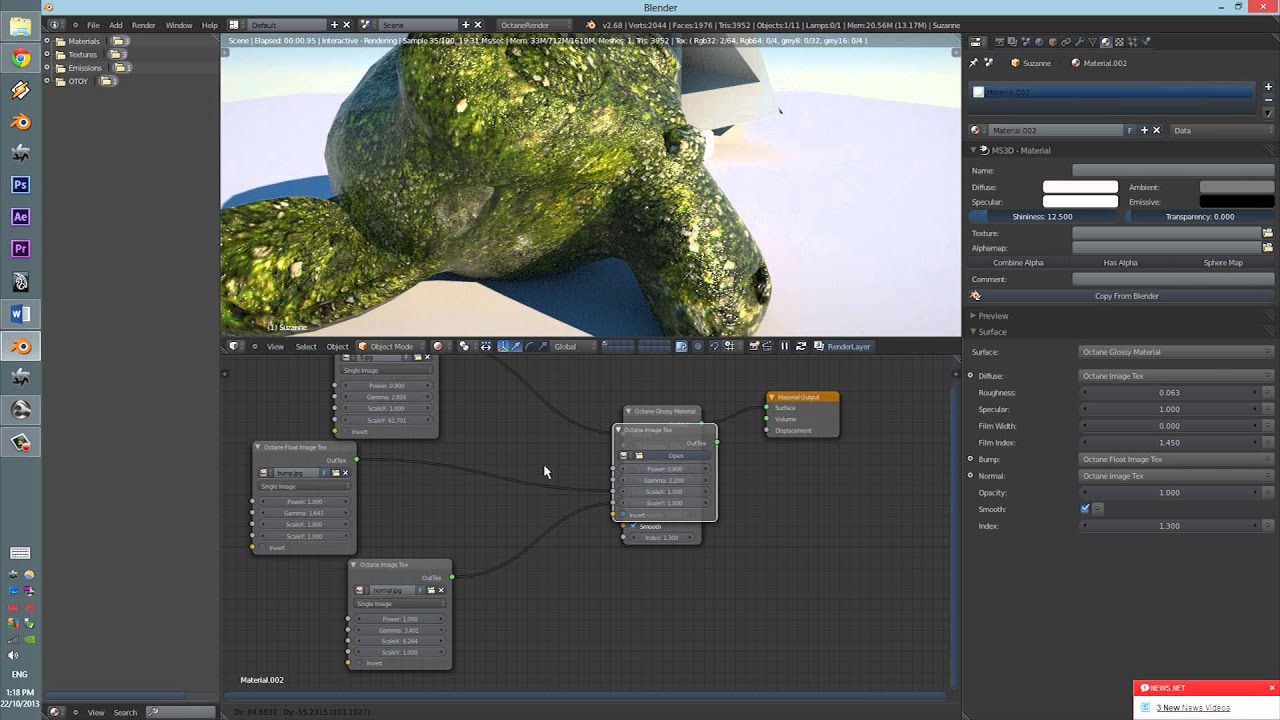

What is OctaneRender? OctaneRender is the world’s first and fastest GPU-accelerated, unbiased, physically correct renderer. What does that mean? It means that Octane uses the graphics card in your computer to render photo-realistic images super fast. With Octane’s parallel compute capabilities, you can create stunning works in a fraction of the time.
OTOY® once again advances the state of the art of GPU rendering with the release of OctaneRender 4™ - available now - with groundbreaking machine learning techniques, out of core geometry support and massive 10-100x speed gains in the scene graph. Octane Render is a GPU based, un-biased, physically based renderer that supports Blender. It uses the processor in your Nvidia GeForce 8000 (or higher) graphicscard. Octane is priced at €99.
The release of the new OctaneRender 3, brings new state-of-the-art tools never seen before in any production renderer. Features include volumetric light field primitives and deep motion buffers for high frame rate VR rendering. The release also incorporates important industry standards for GPU rendering, including Open Shader Language (OpenSL) and OpenVDB for particle simulation.
Use OctaneRender to create images of the highest possible quality at speeds up to 50x faster than CPU-based, unbiased renderers. Attached to your editing tools? Octane supports more than 21 plugins and has a fully interactive, real-time 3D editing viewport. And with Octane 3.0 we provide integration to a beta version of the new Octane Render Cloud to scale for all of your on-demand GPU compute needs. Downloads for free from below links.
Octane Render 3.07 (X64) RELEASE INFO: Octane Render 3.07 360.5 MB OTOY Inc. Has released an updated Octane Render 3, the fastest GPU-based, unbiased renderer. Create works in a fraction of the time of traditional methods. New features of 3.07: – Object controls for the OctaneRender viewport We added the possibility to modify placement and scatter nodes using handles for rotation, scaling and translation in the viewport.
Since OctaneRender is not a 3D modeling software, this will not modify any mesh geometry, but we may add an additional transformation pin to mesh and volume nodes in the future. This way you wouldn’t have to explicitly create placement or scatter nodes to be able to move meshes around.  – New emitter options 'Visible on diffuse', 'Visible on specular', 'Cast shadows' We re-labelled the emitter option 'Cast illumination' to 'Visible on diffuse', because that’s what it does. We also added the option 'Visible on specular' to emitter nodes which is kind of complementary controls the visibility of emitters on specular surfaces. And last but not least we added an option 'Cast shadows' to the emission nodes. If the option is disabled no shadow rays are traced during the direct light calculation causing objects to lose their shadows.
– Double-sided emitters We also added an option to make emitters double-sided. The emitter on the left of the example below has the option 'Double-sided' enabled. – Transparent emission We added a new option 'Transparent emission' to the emission nodes to allow the user to choose whether the emission power should be scaled with opacity or not. Until now, transparent emitters were always taken fully into account even if they were transparent, i.e. They behaved as if 'Transparent emission' is enabled. This is useful if you want to control the light in your scene without your emitters being directly visible.
But there are cases when transparent emitters should not emit light, for example if you would like to modulate an emitter surface using opacity. – Improved rendering of non-uniformly scaled emitters Until now, non-uniformly scaled emitters were rendered incorrectly. The problem was that in that case the direct light sampling was done non-uniformly, too, resulting in artifacts in some corner. – Importance sampled texture environment for all textures Until now, only image textures could be used for importance sampled environments, but now you can mix and match different textures while still using importance sampling. Since importance sampling of the environment makes only sense if it’s not constant, Octane tries to figure out if the input texture actually is constant or not and implicitly disables importance sampling if it is, but it’s probably best to manually disable 'importance sampling' if you don’t want to use importance sampling. – User defined instance IDs We added the possiblity for plugins (or Lua scripts) to explicitly define instance IDs in all geometry nodes except the volume node. This alone isn’t terribly useful, but combined with two new textures plugins can now explicitly define colours for instances.
- Author: admin
- Category: Category
What is OctaneRender? OctaneRender is the world’s first and fastest GPU-accelerated, unbiased, physically correct renderer. What does that mean? It means that Octane uses the graphics card in your computer to render photo-realistic images super fast. With Octane’s parallel compute capabilities, you can create stunning works in a fraction of the time.
OTOY® once again advances the state of the art of GPU rendering with the release of OctaneRender 4™ - available now - with groundbreaking machine learning techniques, out of core geometry support and massive 10-100x speed gains in the scene graph. Octane Render is a GPU based, un-biased, physically based renderer that supports Blender. It uses the processor in your Nvidia GeForce 8000 (or higher) graphicscard. Octane is priced at €99.
The release of the new OctaneRender 3, brings new state-of-the-art tools never seen before in any production renderer. Features include volumetric light field primitives and deep motion buffers for high frame rate VR rendering. The release also incorporates important industry standards for GPU rendering, including Open Shader Language (OpenSL) and OpenVDB for particle simulation.
Use OctaneRender to create images of the highest possible quality at speeds up to 50x faster than CPU-based, unbiased renderers. Attached to your editing tools? Octane supports more than 21 plugins and has a fully interactive, real-time 3D editing viewport. And with Octane 3.0 we provide integration to a beta version of the new Octane Render Cloud to scale for all of your on-demand GPU compute needs. Downloads for free from below links.
Octane Render 3.07 (X64) RELEASE INFO: Octane Render 3.07 360.5 MB OTOY Inc. Has released an updated Octane Render 3, the fastest GPU-based, unbiased renderer. Create works in a fraction of the time of traditional methods. New features of 3.07: – Object controls for the OctaneRender viewport We added the possibility to modify placement and scatter nodes using handles for rotation, scaling and translation in the viewport.
Since OctaneRender is not a 3D modeling software, this will not modify any mesh geometry, but we may add an additional transformation pin to mesh and volume nodes in the future. This way you wouldn’t have to explicitly create placement or scatter nodes to be able to move meshes around. – New emitter options 'Visible on diffuse', 'Visible on specular', 'Cast shadows' We re-labelled the emitter option 'Cast illumination' to 'Visible on diffuse', because that’s what it does. We also added the option 'Visible on specular' to emitter nodes which is kind of complementary controls the visibility of emitters on specular surfaces. And last but not least we added an option 'Cast shadows' to the emission nodes. If the option is disabled no shadow rays are traced during the direct light calculation causing objects to lose their shadows.
– Double-sided emitters We also added an option to make emitters double-sided. The emitter on the left of the example below has the option 'Double-sided' enabled. – Transparent emission We added a new option 'Transparent emission' to the emission nodes to allow the user to choose whether the emission power should be scaled with opacity or not. Until now, transparent emitters were always taken fully into account even if they were transparent, i.e. They behaved as if 'Transparent emission' is enabled. This is useful if you want to control the light in your scene without your emitters being directly visible.
But there are cases when transparent emitters should not emit light, for example if you would like to modulate an emitter surface using opacity. – Improved rendering of non-uniformly scaled emitters Until now, non-uniformly scaled emitters were rendered incorrectly. The problem was that in that case the direct light sampling was done non-uniformly, too, resulting in artifacts in some corner. – Importance sampled texture environment for all textures Until now, only image textures could be used for importance sampled environments, but now you can mix and match different textures while still using importance sampling. Since importance sampling of the environment makes only sense if it’s not constant, Octane tries to figure out if the input texture actually is constant or not and implicitly disables importance sampling if it is, but it’s probably best to manually disable 'importance sampling' if you don’t want to use importance sampling. – User defined instance IDs We added the possiblity for plugins (or Lua scripts) to explicitly define instance IDs in all geometry nodes except the volume node. This alone isn’t terribly useful, but combined with two new textures plugins can now explicitly define colours for instances.